
The field of marketing is full of unicorns.
Myths.
Ancient wisdom.
Here’s one: “The only real goal of marketing is to drive sales.”
Is it?
I mean, sure. We need to drive revenue.
But it’s not the singular objective.
“When we quit thinking primarily about ourselves and our own self-preservation, we undergo a truly heroic transformation of consciousness.”
A purely sales-focused approach to marketing can actually hurt the bottom line in the long run.
How? Let’s say a brand invests in a campaign that casts a wide net, makes a very convincing pitch, and significantly boosts sales. Mission accomplished, right?
Not so fast.
Long-term success will largely depend on another key factor: customer expectations vs satisfaction.
A great campaign might convince people to buy. It might even do it without blatantly misleading them (hopefully). But that doesn’t mean the customers will be happy.
Leave enough customers feeling unsatisfied and your brand will lose trust. Some very big brands have taken big financial hits from campaigns that initially boosted sales but eventually lost trust.
Red Bull’s famous “Gives You Wings” campaign is just one example.
After a class-action suit back in 2014, they ended up paying out $13 million.
Setting realistic expectations is important. Do your demographic research, too, because marketing something to the wrong people can be just as dangerous as having a poor product or creating unrealistic hype.
Drinking the Customer-First Kool-Aid

How can marketers ensure better long-term success? One approach is taking customers’ needs into consideration early in the process. In the industry, this is called “customer-first marketing.”
How does it work?
To help answer that question, I attended a conference in New York City called C3 a few years ago.
The conference was hosted by Conductor, an SEO and marketing software company. According to their guidebook: “Customer-first marketing is a strategy by which businesses create their products, content, and marketing campaigns so that they serve their customers first, and their organization second.”
Sounds great, right?
It also sounds suspiciously like sales rhetoric.
After all, Conductor is a B2B company. They sell a product. Is it possible for marketing to be altruistic and generate a profitable ROI? Are the people at Conductor true visionaries or just peddling their own personal brand of marketing Kool-Aid?
Spoiler: It’s pretty legit.
Inbound vs. Outbound

The unifying theme at C3 back in 2018 was using inbound marketing (i.e. SEO and content marketing) as a tool to help prospective customers find useful information and make more informed choices.
This is certainly a big shift from old-school outbound strategies (billboards, ads, commercials), but it’s also not a new concept. I did it for years as a content marketer in the outdoor retail industry and I’m doing it now as a marketer in the field of online higher education.
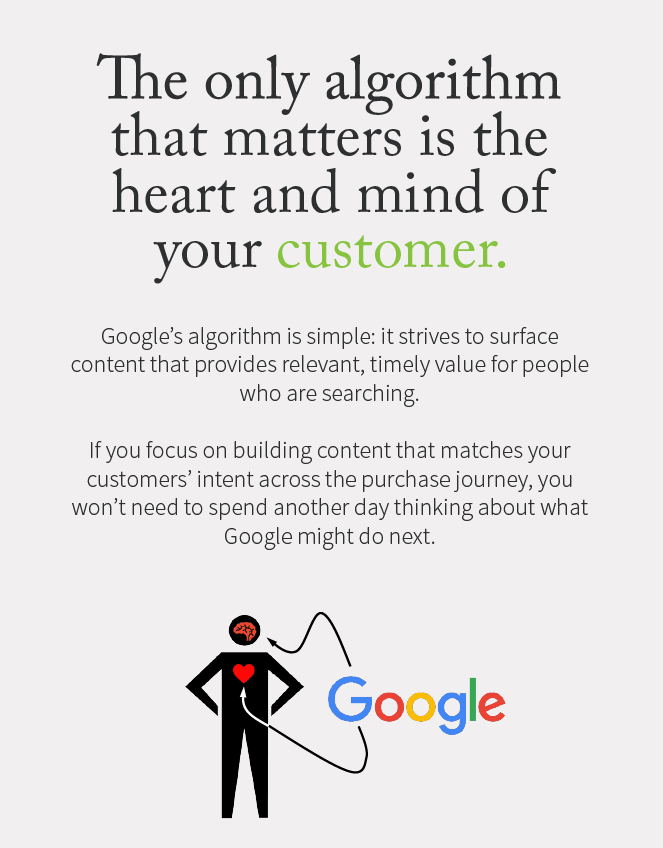
According to the people at Conductor, the internet has made customers more empowered to educate themselves before investing in a product. This is something that many successful brands are using to their advantage. The snippet below from Conductor’s Customer-First Marketing Guide summarizes the concept of using search marketing to simultaneously achieve two things:
Primary Goal: Help people find helpful, accurate, and timely information.
Bonus: People discover (or rediscover) your company or brand.
Conductor recommends taking a three-step approach to customer-first marketing:
Find opportunities to solve problems for current/potential customers.
Build/update your content to fill gaps where customers are searching but not finding you.
Empower every team within your organization to use customer data to make business decisions that benefit customers and, ultimately, grow business.
This all sounds fantastic in theory, and I already know it works in the world of eCommerce, but what about other industries? Can this work for higher education? Giant telecommunications conglomerates? Friendly neighborhood small businesses?
Less About Us — More About You

Switching focus is the first step in customer-first marketing. The focus is no longer how awesome a company, brand, or product is. The customer is the focus.
Catherine McManus, Senior Director of Content Marketing at Aetna (a managed health insurance company), recommends investing in original content that inspires, educates, and empowers the audience. She backs up her logic with examples from a rebranding campaign, including several videos. The unifying slogan is: “You don’t join us. We join you.”
The videos show an empowering side of the health insurance industry, emphasizing customer stories.
One example is Nikki’s Story, a video from the “My Health Story” campaign.
The theme of Aetna’s current marketing strategy is helping customers gain more control over their healthcare, which bears out nicely on the company’s microsite with informative text and video content on a variety of common health-related topics.
When creating a content strategy, Catherine recommends asking these questions:
What’s causing the most confusion for customers? What questions are they asking?
How can you create original, high-quality content that answers these questions?
How do you deliver that information in an engaging way?
For Aetna, one avenue was “Healthcare answers in sixty seconds,” a supporting campaign that includes short videos explaining the difference between healthcare providers, HSAs vs. FSAs, and other questions that customers often misunderstand.
Aetna is capitalizing on the customer-first strategy, and I certainly hope their actual products and services are as customer-focused as their content appears to be.
At the very least, Aetna is leveraging a type of marketing that isn’t overtly selling. Instead, it’s trying to help customers become more informed and hopefully make better choices that could improve their quality of life.
Although the end goal may not be purely altruistic, the strategy for achieving that goal can provide people with value, and that value is given free of charge, whether people become customers or not.
This last point, in my opinion, is the most integral part of genuine customer-first marketing.
Moving Closer to a Customer-Centric World

Jennifer Anderson, Executive Director of Digital and Social Media at Sealed Air, recommends ditching old marketing strategies that start every customer interaction by talking about the company. Instead, find ways to help the customer by understanding their problems and offering solutions.
Jennifer calls this knowledge-based marketing.
Basically, if your business, products, and services are legit, you can only benefit from having more informed customers. This strategy might include giving customers clear and transparent information about what you offer compared to your primary competitors. This is the exact approach Progressive uses to gain customer trust.
Also, don’t assume that every customer has only just now heard about your brand or product.
According to Jennifer, a large segment of people are actually more than halfway through the customer journey by the time they speak with a sales rep or add something to their virtual or physical shopping cart.
Not surprisingly, the majority of customers have already spent time investigating a product and/or brand online prior to making a purchase. This “consideration cycle” may be short for smaller purchases, like a new pair of sneakers, or much longer for big investments like a new car or applying to a master’s degree program.
Here are a few more quick statistics from PR expert Cheryl Snapp Conner:
Consumers who read educative content are 131% more willing to buy.
78% of those consumers consider the company that provided that content to be helpful.
64% of those consumers consider that company to be trustworthy.
After a week, consumer trust increases to 73%.
By continually providing customers with valuable information and knowledge at no cost, brands earn trust and stay top of mind. In the outdoor retail industry, this can be as simple as providing an instructional article and video on how to choose the right pair of skis. REI does this well.
For an online college or university, they might offer free online courses in foundational business skills or an informative webinar series on personal finance.
Free, downloadable ebooks work well (if they are designed well), especially when they offer original research and data.
Your goal is to provide something valuable and genuinely helpful with no expectations.
Today’s customers are more self-educated, and the competition for people’s attention, time, and hard-earned dollars grows every day. That’s why inbound marketing is less about selling and more about helping.
“If you want to show up in search engines, you have to create the best content,” explains Seth Besmertnik, CEO of Conductor. “If you want to win customers in this modern world, create something that delivers value, that’s meaningful. It’s putting your customer first, it’s understanding their needs, and it’s working backwards to make sure that what you’re providing is what they actually need and want.”
In my opinion, customer-first marketing isn’t just good for customers, it’s also the most sustainable, cost-effective marketing strategy for long-term success.
This post was original published on Medium.com by Beren Goguen.